Ciberataque “ransomware” a Empresas

Etiquetas

, , , , ,

hacking-1685092_960_720

El último viernes 12 de mayo: un enorme ciberataque ha golpeado sistemas informáticos en decenas de países y empresas. El virus conocido como “ransomware”.

Ciberataques a diferentes países.
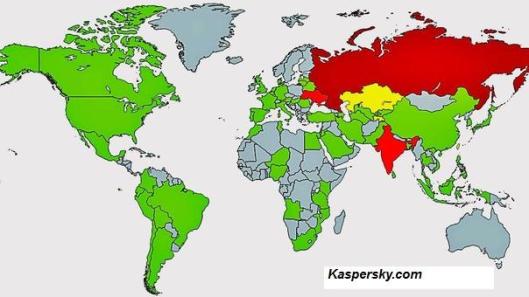
Cyberataques

La mayor parte de las empresas no están preparadas para ciberataques. Sus estructuras tienen agujeros, que facilitan puntos de ataque y no cuentan con planes de contingencia.

En el sistema sanitario del Reino Unido (NHS) el ataque ha afectado a ordenadores y teléfonos móviles de 12 hospitales y centros de salud de Londres, Nottingham, Herefordshire, Blackburn y Cumbria. El ataque ha obligado a apagar los ordenadores y a cancelar citas.

Ransomware

Es un programa malicioso (malware) que bloquea los ordenadores personales y dispositivos móviles-tabletas, teléfono- o cifra los archivos de los equipos infectados para impedir el acceso al usuario.

Top de familias Ransomware de Diciembre de 2015 a Mayo del 2016

Ransomware familias

Los ciberdelincuentes envían un mensaje donde piden una cantidad de dinero para desbloquear el equipo y recuperar los datos. Este bloque no supone fuga de datos.

El programa se transmite como un troyano o como un gusano, infectando el sistema operativo.

A través de:

  • Un correo electrónico que remite a un enlace de una página de internet
  • Descargando un fichero adjunto
  • Navegando por la red
  • Bajando programas como Windows o Adobe Flash
  • Videos de páginas de dudoso origen

WannaCry

Es un sansomware “activo” que ha aparecido el 12 de mayo de 2017, provocó el cifrado de datos en más de 75 mil ordenadores, se ha expandido por Estados Unidos, China, Rusia, Italia, Taiwan, Reino Unido y España.

Los sistemas operativos más vulnerables:

  • Windows Vista
  • Windows 7
  • Window Server 2012
  • Windows 8.1
  • Windows 10
  • Windows Server 2016

Bitcoins

Criptomonedas: Dash, Zerocoin o Cloakcoin tienen servicios de mixing (mezclar unos fondos con otros), se juntan las transacciones en un pool en el que se pierde el rastreo.

Programas anti-APP o sandbouxing

Los programas tradicionales no son suficientes. Los mejores son los programas de anti APP o sandbouxing, que rastrean el comportamiento del sistema o de la red de información, identificando cualquier software malicioso y lo eliminan.

Desmotando el Ciberataque del viernes 12

Warren Mercer un líder de seguridad técnica de Cisco, investigador de seguridad, en el Reino Unido, encontró que el interruptor fue codificado en el ransomware: “en caso de que el propagador quisiera detener su propagación”. Esto se hizo a través de un nombre de dominio muy largo que el malware tuvo que conectarse. Si la conexión es correcta y muestra un dominio en vivo, el “kill switch” funciona, se apaga inmediatamente y se detiene la propagación del ransomware.

Microsoft descubrió esta vulnerabilidad en el boletín de seguridad MS17-010, y los ingenieros añadieron este viernes “detección y protección contra el nuevo software malicioso”:

Ransom.Win32.WannaCrypt


Bibliografía:

  • Microsoft
  • Cyberwar.Kaspersky.com

Links relacionados:

  • Ciberataque” Universidad Loyola Andalucía

https://www.youtube.com/watch?v=W0GJx26Ywic

  • Ransomware” Power Director

https://www.youtube.com/watch?v=StinIMYEq7c

  • Mapa ciberataques tiempo real” Cyberwar.Kaspersky.com

https://www.google.es/url?url=https://cybermap.kaspersky.com/&rct=j&frm=1&q=&esrc=s&sa=U&ved=0ahUKEwixxLbQt_LTAhVHVhoKHQICDEYQFggUMAA&sig2=llWn70ovCKpTMHo5vmNftA&usg=AFQjCNEgheWfyimN_RrE0xqYB5ejli81PA

Innovation: Business Experimentation

Etiquetas

, , , ,

laboratory-2082357_960_720

Accoding to Thomke a team organize a project for rapid iteration in order to exploit early information through “front-loaded” innovation porcesses, and experimenting frequently without overloading the organization.

Virtual experimentation and simulation enable new ways of working in R&D, in part by allowing, faster and more through experimentation and testing, minimizing physical product tes failure, enabling co-creation with customers, and supporting cross-discipline integration.

Virtual experimentation and simulation are not only about emerging technologies. Implementing these tolos effectively requires attention to a host of management issues, from decisions about investment and development to attention to processes and organizational resources to support them, to thinking about how they affect the approach to R&D.

The Virtual Experimentation & Simulation project is one o the groups working under the aegis of IRI´s research platform Digitilization and its implications for R&D Management. Designed to explore a broad range of issues relevant to digitalization and its likely effects on R&D organizations today and in the future, the platform incorporates three research groups:

  • Big Data: this tea mis focused on understanding how big data will inform, enable, and disrupt R&D, by examining it through the lenses of R&D strategy, human capital, technology, and process integration.
  • Collaboration: is comparing virutal and physical collaboration spaces with the object of identifying how collaboration may become boundaryless over time.
  • Virtual Experimentation & Simulation: is looking at the principles surrounding virtual spaces and their uses with an eye toward indetifying principles and best practices for determining when a virtual environment should be employed.

This potential for new kinds of exploration of the design space allows developers to learn about their designs in new ways, while at the same time continuosly improving their models to better represent reality.


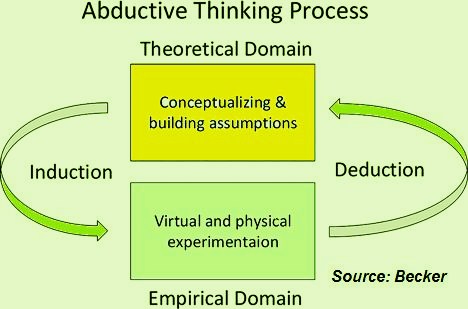
Aductive Thinking Process

The abductive thinking process: the impact of virtual simulation tools on problem-solving and new product development organization. A paradigm will occur when simulation not only replaces physical tests and human thinking processes, but also enables new combinations o experiments and new ways of approaching and understanding phenomena.

Experimentation, a form of problem-solving, is a fundamental innovation activity and accounts for a significant part of total innovation cost and time. In many fields, the economics of experimentation are being radically affected by the use of new and greatly improved versions of methods such as computer simulation, mass screening, and rapid prototyping.

Employees working under high risk-taking climates tend to believe that their organization will defend them against risky external environments and tend to feel safeguarded from interpersonal and career risks, such that they do not fear material or reputational harm.

Management science and engineering management research have attempted to answer questions related to how often, when, and at what level o fidelity prototypes should be created and tested base don an organization´s schedule and budget.

Stefan H. Thomke, an authority on the management of innovation, is the William Barclay Harding Professor of Business Administration at Harvard Business School.

He is a widely published autor with more than one hundred articles, cases and notes published in books an leading journal. He is also autor of the books: “Experimentation Matters: Unlocking the Potential of New Technologies for Innovation” and “Managing Product and Service Development


Bibliography:

  • Anita Friis Sommer & Steven Moskowitz, “Leveraging Virtual Experimentation and Simulation in R&d”, Online, 2016
  • Becker, M.C., Salvatore,P., and Zirpoli, F. “The impact of virtual simulation tolos on problema-solving and new product development organization”. Research Policy. 2005
  • S.H. Thomke, “Managing experimentation in the design of new products”, Researcher. 1998
  • S.H. Thomke, “Experimentation Matters: Unlocking the Potential of New Technologies for Innovation”, Harvard Business School Press. 2003
  • S.H. Thomke, “Managing Product and Service Development”, McGraw-Hill/Irwin. 2006


Links relationated:

  • Harvard Business Experimentation

https://hbr.org/2014/12/the-discipline-of-business-experimentation

  • Stephan Thomke from Harvard Business Schooll

https://www.youtube.com/watch?v=wn6EkFJ4q7g

¿Se pueden producir cervezas con bacterias lácticas?

Etiquetas

, , , , , , , , , ,

beer.jpg

La cerveza es una bebida alcohólica, no destilada, de sabor amargo, que se fabrica con granos de cebada germinados u otros cereales cuyo almidón se fermenta en agua con levadura ( fundamentalmente son Saccharomyces cerevisae , Saccharomyces pastorianus o Saccharomyces carlsbergensis) y se aromatiza con lúpulo.

La fermentación es un proceso que se realiza en condiciones anaeróbicas (ausencia de oxígeno) que puede generan como producto final ácido láctico (fermentación láctica, por las bacterias ácido-lácticas) o etanol (fermentación alcohólica por levaduras).

Fermentación láctica:

Glucosa…………………………………….ácido láctico + energía +H2O

Fermentación alcohólica:

Glucosa…………………………………….etanol + energía + CO2

Las cervezas se obtienen por fermentación de cereales malteados. Así la malta libera los azucares que hay en el almidón fermentados posteriormente con las levaduras.

Taxonomía de las bacterias lácticas:

  • Dominio: Bacteria
  • Filo: Firmicutes
  • Clase: Bacili
  • Orden: Lactobacillates
  • Familia: lactobacillaceae
  • Generos: Por su morfología y el tipo de fermentación

Cocos: – formadores de tétradas

Homofermentadora: Pediococcus/ P. cerevisae

formadores de cadenas

Homofermentadora: Streptococcus ( Enterococcus, Vagococcus, Lactococcus)

Heterofermantadora: Leuconostoc

Bacilos: – grupo de Lactobacillus

Homofermentadora: Thermobacterium, Streptobacterium

Heteroermentadora: Betabacterium

-grupo de Carnobacterium

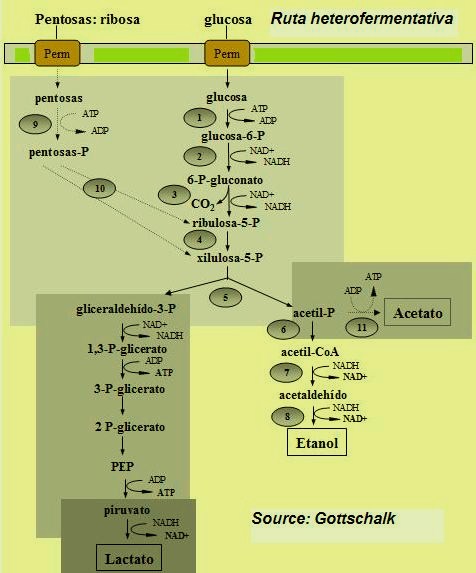
Ruta Homofermentativa y Heterofermentativa

ruta heterofermentativa


El grupo de bacterias Homofermentativas producen el ácido láctico, y el grupo Heterofermentativas , producen etanol y CO2 además de ácido láctico.

En la fermentación heteroláctica algunas bacterias lácticas carecen del enzima fructosa-1, 6-P aldolasa y no pueden utilizar la ruta glucolítica para el metabolismo de hexosas. Así los azúcares se pueden incorporar a la ruta de las pentosas fosfato. La hexosa es necesario transformarla en una pentosa y el precio metabólico son las dos reacciones de deshidrogenación. El balance global de la fermentación de un mol de glucosa por la vía heterofermentativa es un mol de lactato, uno de etanol y uno de CO2 y un rendimiento energético de un mol de ATP.

La fermentación láctica es responsable de la producción de productos lácteos acidificados: yogurt, quesos, cuajada, crema ácida, etc. también vemos como por la fermentación heterofermentativa lactobacillus como Pediococcus cerevisae pueden transformar la glucosa del trigo o la cebada en etanol. Algunas cervezas usan ácido láctico en su elaboración como las Gose y las Berliner Weisse alemanas, dando una cerveza ácida.

Bibliografía:

  • K.A. Jacques; Lyons, T & Kelsall, D. “The Alcohol Textbook” 4 Edition. Nottingham University press. 2003.
  • Gottschalk, G. “Bacterial Metabolism.” Springer-Verlag. New York. 1979
  • Wikipedia

Links relacionados:

  • Beer microbes

https://www.youtube.com/watch?v=J-IwgVMgZy4

  • Fermentación alcohólica y láctica

https://www.youtube.com/watch?v=jWyA9xlugyc

  • Berliner Weisse, sour wort process

https://www.youtube.com/watch?v=ucHtiqFm1eI


Innovation: Portfolio Management

Etiquetas

, , , , ,

porfolio management

Enterprise Project Portfolio Management (EPPM) is the practice of taking a top-down approach to managing all Project-intensive work and resources across the Enterprise.

Project portfolio management (PPM) refers to a process used by Project managers and Project management organizations (PMOs) to analyze the potential return on a doing a project. A key result of PPM is to decide which projects to fund in an apotimal manner. Project Porfolio Optimizaction (PPO) is the effort to make the best decisions posible under these conditions.

PPM and project management differ by number of projects. Project management looks to focus on an individual project´s, whereas project portfolio management takes into consideration every project or potential project and its viability.

PPM provides program and project managers in largue, program/project-driven organizations with the capabilities needed to manage the time, resources, skills, and budgets necesary to accomplish all interrelated tasks. These can include financial resources, inventory, human resources, technical skills, production and design.

Cooper 2

The objectives of PPM are to determine the optimal resource mix for delivery and to schedule activities to best archieve an orgaizations´s operational and financial goals, while honouring constraints imposed by customers, strategic objectives, or external ral-world factors.

The key aims of EPPM can be summarized as follows:

  • Prioritize hte right projects and program
  • Eliminate surprises: process to indentify potential problems earlier in the project lifecycle, to take corrective action before they impact financial results.
  • Build contingencies into the overall portfolio
  • Maintain response flexibility: quickly respond to escalating emergencies by maneuvering resources from other activities.
  • Do more with less: to ensure a consistent approach to all projects, programs, and portfolios while reducing costs.
  • Ensure informed decisions and governance
  • Extend best practise-wide
  • Understand future resource needs

Types of Portfolio Management:

  • Active Portfolio Management: the portfolio managers are actively involved in buying and selling of securities to ensure máximum profits to individuals.
  • Passive Portfolio Management: the portfolio manager deals with a fixed designed to match the current market scenario.
  • Discretionary Portfolio management services: an individual authorizes a portfolio manager to take care of his financial needs on his services.
  • Non-Discretionary Portfolioi management services: the portfolio manager can merely advise the client what is good and bad for him but the client reserves full right to take his own decisions.

The project portfolio management process helps companies predict the outcome and plan for projects that will offer the best results. It helps companies break down every detail of a proposed project-budgets, resources, tasks, timelines and goals. Using in-depth analysis of proposed projects, weighed against current projects, a company can define what risks offer the most rewards.


Dr. Robert G. Cooper is a Professor Emeritus of Marketing and Technology Management at University in Ontario, Canada. Is one of the most influential innovation thought leaderes in the business world today. He is considere one of the most important discoveries in the field innovation management. He has published more than 100 academic articles and eleven books, including: “ Portfolio Management for New Products”.

Bibliography:

  • Robert G. Cooper, Scott J. Edgett, Elko J. Kleinschmict; “Portfolio Management for new Products: Second edition. Hardcover”. January, 2002
  • Wikipedia

Links relationated:

  • Harvard University: management porfolio

https://hbr.org/2012/05/managing-your-innovation-portfolio

  • Economics from Oxford: management porfolio

https://academic.oup.com/rfs/article-abstract/9/2/511/1631102/Portfolio-Performance-Measurement-Theory-and

  • Robert G. Cooper and porftolio

https://www.youtube.com/watch?v=pcxPoVLE7PI


The theory of disruptive innovation

Etiquetas

, , , , , ,

the theory disruptive

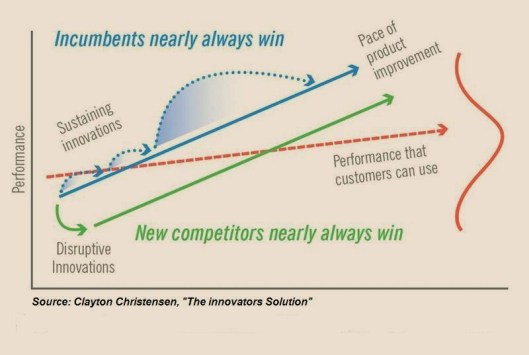
It was invented by Clayton Christensen, of Harvard Business School, in his book “The Innovator´s Dilemma”. Christensen used the term to describe innovations that create new markets by discovering new categories of customers.

He contrasted disruptive innovation with sustaining innovation, which improves existing products.

Empirical teste show that using disruptive theory makes us measurably and significantly more accurate in our predictions of which businesses will succeed.

The “innovator´s dilema” is the difficult choice an established company faces when it has to choose between holding an existing market by doing the same thing a bit better, or capturing new markets by embracing new technologies and adopting new business models.

Disruptive innovations usually find their first customers at the bottom of the market: as unproved, often unpolished, products, they cannot command a high Price. Incumbents are often complacent, slow to recognise the threat that their inferior competitors pose.

Clayton Magleby Christensen is an American business consultant, Professor of Business Administration at the Harvard University, is expert on innovation and growth. From 1979 to 1984 worked as a consultant and Project manager with the Boston Consulting Group (BCG),where worked strategy consulting. In 2000, Christensen founded Innosight a consulting firm that uses his theories of innovation to help companies create new growth businesses. In 2007, he founded Rose Park Advisors, a firm identifies and invests in disruptive companies.

The theory of disruptive innovation, has proved to be a powerful way of thinking about innovation-driven growth. Many leaders of small, entrepreneurial companies praise it as their guiding star; so do may executives at large, well-established organizations. This theory has been enormously influential in business circles and a powerful tool for predicting which industry entrants will succeed.

disruptive_innovation_21

Disruption” describes a process in which a smaller company with fewer resources i sable to successfully challenge established incumbent businesses. Specifically, as incumbents focus on improving their products and services for their most demanding customers, they exceed the needs of some segments and ignore the needs of orders.

Disruptive innovations origínate in low-end or new-market footholds. In a new-market footholds, disrupters create a market where none existed. Put simply, they find a way to turn nonconsumers into consumers. Disruptive innovations don´t catch on with mainstream customers until quality catches up to their standards. Are initially considered inferior by most of an incumbent´s customers. The customers wait until its quality rises enough to satisfy them. Once that´s happened, they adopt the new product and happily accept its lower Price.

Disrupters often build business models that are very different from those of incumbents.

Some disruptive innovations succeed; some don´t. Companies that rise to the top in very different ways will be seen as sources of insight into a common strategy for succeeding. Managers may mix and match behaviours that are very likely inconsistent with one another and thus unlikely to yield the hoped-for result. When an entrant tackles incumbent competitors head-on, offering better products or services, the incumbents will accelerate their innovations to defend their business.

Incumbents rarely responded effectively to disruptive innovations, not why entrants eventually moved upmarket to challenge incumbents, over and over again. The same forces leading incumbents to ingore early-stage disruptions also compel disrupters ultimately to disrupt. Researchers realized that a company´s propersity for strategic change is profoundly affected by the interests of customers who provide the resources the firm needs to survive. Incumbents listen to their existing customers. Incumbents´s focus on their existing customers becomes institutionalized in internal processes that make it difficult for even managers to shift investiment to disruptive innovations.

New-market disruptions take hold in a completely new value network and appeal to customers who have previously gone without the product.

The theory with the time has become more powerful and practicable.

Bibliography:

  • Clayton M. Christensen, “The Innovator´s Dilemma”, Harvard Business School Press, 1997
  • Clayton M. Christensen, Michael E. Raynor, Rory McDonald, “ What is Disruptive Innovation?, Harvard Business Review, December, 2015
  • Clayton M. Christensen, “Strategy & Innovation”,
  • A. W., “What disruptive innovation mean”, The Economist, Jan, 2015
  • Daniel Goleman, “Leadership & Managing People”, 2017
  • Wikipedia

Links relationated:

  • Clayton M. Christensen

http://www.hbs.edu/faculty/Pages/profile.aspx?facId=6437

  • Innosight

http://www.claytonchristensen.com/ideas-in-action/innosight-consulting/

  • Disruptive innovation

https://www.youtube.com/watch?v=rpkoCZ4vBSI


Innovation: types of creativity

Etiquetas

, , , , ,

creativity types

Kerrie Unsworth (is a Professor at Leeds University Business School, interested in studying motivation, creativity, pro-environmental behaviours and well-being), poposed in “Unpacking creativity” (2001) that there was more than just raw intelligence that influenced the creativie process. She argues that context was just as important of a factor of creativity as cognitive ability was. Looked two aspects of context: the problem type and motivation.

Closed problems: are instances when a problem is clearly.

Open problems: must be discovered and searched for.

Using the different types of motivation and problems, Unsworth created a matrix that broke down creativity into four arch-types.

Unsworth

Responsive Creativity

  • Most prevalent form of creativity studied
  • Individuals do a previously set creativity problema or task and complete it given the external demands and requirements
  • Individual has the least control over problema solving choice
  • We decide to create mor efficient ways for making it for management

Expected Creativity

  • External goal or outcome with a selfdiscovered solutions selected by the problema solvers
  • Select from a set the particular problems/ issues about which they will think creatively and conbribute their responses
  • Open Managenement want us to find ways of making it

Contributory Creativity

  • Individuals self-determined and based upon a problem clearly formulated by others
  • Individuals who elect to engage in creativity to help solve problems with which they are not directly involved
  • We want to discover way fo making it for ourselves

Proactive Creativity

  • Individuals think creatively about open ended issues and problems that interest them
  • Individuals spontaneously provide creative proposals that were not requested
  • Difficult but important to assess

Implication of this analysis for creative thinking is that the types of creative thinking in several ways, the creative process may change depending upon the type of creativity:

Creative is more constrained, when they are engaging in creative thinking for external reasons and are doing tasks or problems that are more closed.

Creative will be stronger, when requiring more effort (proactive and contributory creativity) than for types requiring more effort (responsive and expected creativity)

Relationship between motivation and creativity will be stronger for those types requiring more effort (proactive and contributory)

Bibliography:

  • Unsworth, K, “Unpacking creativity”, The Academy of Management Review, 26, (2) 286-297, 2001
  • Wikipedia

Links relationated:

  • Kerrie Unsworth

http://business.leeds.ac.uk/about-us/our-people/staff-directory/profile/kerrie-unsworth/

Innovation: Creativity

Etiquetas

, , , , ,

creativity

Peter Drucker taught us: “The business Enterprise has two basic functions: marketing and innovation”.

Creativity is a phenomenon whereby something new and somehow valuable is formed. The created ítem may be intangible (service) or a physical object (product) what customer demands.

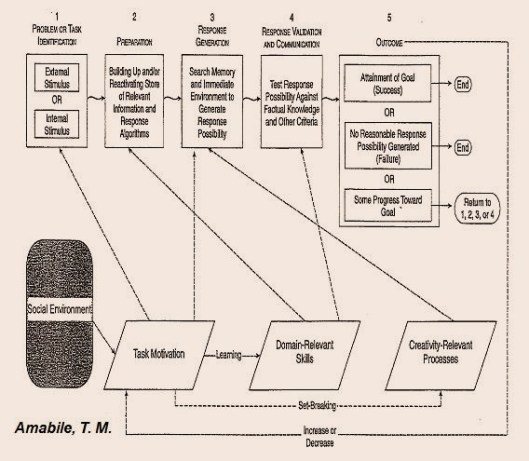
Teresa Amabile, is the Profesor of Business Administration at Harvard Buisness, argued that to enhance creativity in business, three components were needed:

Creativite

  • Expertise (technical, procedural and intelectual knowledge).
  • Creative thinking skills (how flexibly and imaginatively people approach problesm),
  • Motivation (especially intrinsic motivtion)

There are two types of motivation:

  • Extrinsic motivation: external factors,
  • Intrinsic motivation: inside an individual, satisfaction, enjoyment of work

6 managerial practices to encourage motivation are:

  • Challenge: matching people with the right assignments
  • Freedom: giving people autonomy
  • Resources
  • Work group features
  • Supervisory encouragement
  • Organizational support

Two important assumptions underlie the Amabile´s theory:

  1. There is continuum from low, ordinary levels of creativity found in everyday life to the highest levels of creativity found in historically significant inventions
  2. Related underlying assumption is that there are degrees of creativity in the work of any single individual, even within one domain.

According to the expanded theory, has undergone considerable evolution since 1988, intrinsicmotivation and creativity might actually be enhanced, this process is termed “motivacional synergy”, (Amabile, 1993) .

In organization, there are possibilities por innovation facilitates, brainstorming can result in surpresing innovations. A posible attitude, and a low-stress environment, can support the greater mental flexibility and training.


Bibliography:

  • Amabile, T. M, “The Social Psychology of Creativity: A Componential Conceptualization”, Journal of Personality and Social Psycology 45, no2, 1983
  • Carol Kennedy, “Guide to the management gurus”, Random House Business Books, 1991
  • Wikipeda

Links relationated:

  • Teresa M. Amabile: theory of creativity

https://www.youtube.com/watch?v=k5j6uNEdai8


  • Harvard Business School

https://www.exed.hbs.edu/programs/gmp/Pages/default.aspx?lb=fy17:gmp

Innovation: lifecycle

Etiquetas

, , , , ,

cyclelifes


Engaging with open innovation is a difficult process which requires time and an understanding of an orgnanisation´s own processes.

Challenges associated with engaging with open innovation across the lifecycle of a process and a product.

Everett M. Rogers was an American communication theorist and sociologist, who originated the diffussion of innovations theory and introduced the term early adopter. He was distinguished Professor Emeritus in the Department of Communication and Journalism at the University of New Mexico. “Diffusion of Innovations” was published in 1962, it became the second most-cited book in the social sciences.

innovations

Rogers proposes that adoprters of any new innovation or idea can be categorized as:

  • Innovators 2,5%
  • Early adopters 13,5%
  • Early mayority 34%
  • Late maority 34%
  • Laggards 16%

Based on the mathematically Bell curve.

Each adopter´s willingness and ability to adopt an innovation depends on their:

  • Awareness
  • Interest
  • Evaluation
  • Trial
  • Adoption

People can fall into different categories for different innovations. The graph shows acumulative percentage of adopters over time-slow at the start, more rapid as adoption increases, then leveling off until only a small percentage of laggards have not adopted.

Are two types of innovative strategies for a large company:

Sustaining innovation: evolutionary changes in their markets, products, etc. valued by their existing customers, fairly well.

Disruptive innovation: radical shifts in technology, customers, regulatory changes, etc, that create new markets. It is innovation that go after new markets, new customers, new technologies, etc. are best built outside a large company´s existing organization. In a large company is attempting to solve two simultaneous unknowns: the customer/market is unknown, and the product feature set is unknown.

Mastering disruptive innovation in a large company requires:

  • Different people
  • Different processes


Bibliography:

  • Everett Roggers, “ Diffusion of Innovations”, 5th Edition, Ed. Simon and Schuster, 2003
  • Wikipedia


Links relationed:

  • Innovation Management

http://www.innovationmanagement.se/tag/innovation-life-cycle-processes/


Architectural Innovation

Etiquetas

, , , , ,

algebra-1238600_1280


Architectural innovation therefore presents established organizations with subtle challenges that may have significant competitive implications.


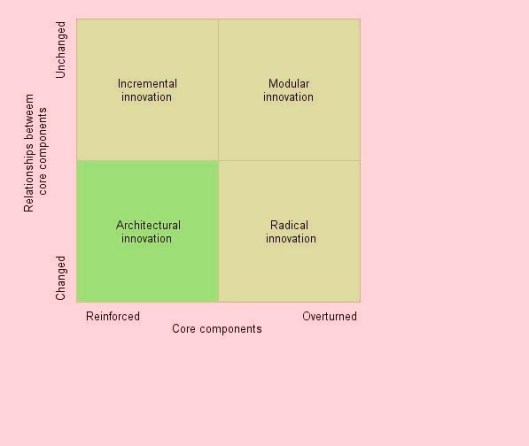
In 1990, Rebecca M. Henderson from MIT and Kim B.Clark from Harvard University wrote an article: “The Reconfiguration of Existing Product Technologies and the Failure of Established Firms”, describe an innovation typology that was base on an innovation´s impacto on core design components and relationships between them.

cuadro


The distinctions between radical, incremental, and architectural innovations are matters of degree


  • Incremental innovation: introduce quality improvements in core components. The Word renovation would more precisely describe this type of innovation.Tends to reinforce the competitive positions or established firms.


  • Modular innovation: may result in the complete redesign of core components, while leaving linkages between the components unchanged.


  • Architectural innovation: changes the nature of internations between core components, while reinforcing the core design concepts.


Is designed to draw attention to innovations that use many existing core design concepts in a new architecture and that therefore have a more significat impacto on the relationships between components than on the technologies of the components themselves.


  • Radical innovations: introduce a new meaning, potentially a paradigm shift.


Creates unmistakable challenges for established firms, since it destroys the usefulness of their existing capabilities.


The concept of architectural innovation and the related concepts of component and architectural knowledge have a number of important implications. Open up new areas in understanding the connections between innovation and organizational capability. An architectural innovation´s affect despends in a direct way on the nature of organizational learning. Learning about changes in architecture-about new interactions across components may therefore require explicit management and attention.


To the degree that manufacturing, marketing, and finance rely on communication channels, information filters, and problem-solving strategies to integrate their work together, architectural innovation at the firm level may also be a significant issue. An understanding of architectural innovation would be useful to discussions of the effect o technology on competitive strategy.


Modular Innovations is where you maintain the architecture and modify and modify the modules. Architectural innovation is where the architecture changes.


Some issues to consider:


  1. By creating incompatibilities you develop lock in features and generate high switching costs.

  2. By developing modules you do not have to change the underlying architecture.

  3. Modular systems shorten PLC.

  4. It stimulates specialization.

  5. Increases scale and differentiation.

  6. Builds alliances.

  7. Competitiors form Satndards organizations to ensure consistency in the development of systems.

  8. Market Power. Sometimes powerful groups and organizations can prevent the best technology from being utilized.

  9. Reduces risk increases investment.

  10. Adoption of new architecture can be slow.

  11. Modular and architectural innovation are the extreme cases.

  12. Modular complementary innovation. Complementary modules emerge that increase the potential of the new module.

  13. Modular transformation, a new module may act as a bridge between two different architecture.

  14. Modular upgrading may occur when a new or improved module spawns complementary modules.

  15. Architectural Knowledge. Occasionally a company not normally seen as a threat transforms the competitie environment.

  16. First Mover Advantage. Building a dominant market share.


Bibliography:


  • Henderson & Clark Architectural innovation: “The reconfiguration of existing product technologies and the failure of established firms”, Administrative Science Quarterly, Vol.35, No.1, Ed. Sage Publications, Inc; Johnson Graduate School o Management, Cornell University.:1990


  • Wikipedia


Links relationed:


  • Harvard Business School

http://www.shepleybulfinch.com/project/harvard-business-school/A42/


  • Rebecca M. Henderson

https://www.youtube.com/watch?v=BBgLJgAZ6wc


Innovation

Etiquetas

, , , , , , ,

innovation

An innovator, is a person who introduces into reality, opens a new area.

Diffusion of innovation research was started in 1903 by researcher Gabriel Tarde. Was a French sociologist, criminologist and social psycologist who conceived sociology as base on small psycological interactions among individuals. Amon the concepts that Tarde initiated were the group mind and economic psychology and the develop.

Tarde defined the innovation-decision process as a series o steps that includes:

  1. First knowledge
  2. Forming an attitude
  3. A decisión to adopt or reject
  4. Implementation and use
  5. Confirmation of the decisión

This process has been proposed that the life cycle of innovations can be described using “s-curve” or “diffusion curve”, s-curve relations the productivity against time.

  • In early stage of a particular innovation, growth is relativey slow,
  • after customers begin to demand and the product growth increases more rapidly
  • Towards the end o its lifecyce, growth slows and maye ven begin to decline
  • In the later stages, no amount of new investment in that product will yield a normal rate of return.

Innovation is the result o a process that brings various novel ideas in a way that they affect society: Industrial economics will typically be working on innovations renewal and enlargement of products, services and markets, development of new methods of production; and establishment of new management systems; and found services to meet the growing consumer demand.

Positive changes in the organizational context:

  • Efficiency
  • Productivity
  • Quality
  • Competitiveness
  • Market sahere

Peter Drucker (Austrian-born American management consultant, educator, and autor, the founder of modern management ), wrote:

Executives and managers need to break away from traditional ways of thinking and use chang to their advantage. It is a time of risk bute ven greater opportunity. The world of work is changing with the increase in the use of technology and both companies and businesses are becoming increasingly competitive”.

Changes in industry structure, in market structure, in local and global demographics, in human perception, mood and menaning, in scientific knowledge, etc.”

Measure of innovation at the organizational level relates to individuals, team-level assessments, and prívate companies with workshops, consultants, or internal benchmarking.

Companies will typically be working on new innovations that will eventually replace older ones.

Bibliografía:

  • Burgher, Peter H, “Changement, Understanding&Managing Business”, Lexington Books, 1979
  • Carl Heyel “ The encyclopedia of management”, Van Nostrand Rinhold Company, 1982
  • Eliot D. Chapple “Culture and Biological man, explorations in behavioral anthropology”, Cornell University, 1970
  • Spencer Johnson “Who Moved my Cheese?”Spencer Jhonson, 1998
  • Tom Peters “Liberation Management” Excel, 1992
  • Wikipedia

Links:

  • Innovation” Harvard

https://hbr.org/topic/innovation

https://i-lab.harvard.edu/